Now Open
Our museum on the National Mall is currently transforming. Eight new galleries are now open, inviting visitors to explore air and space in new ways. We are continuing to work on transforming the building, reimagining more galleries. The reimagined galleries will open in phases over the next few years. While we continue that work, portions of the building will be closed. The full building is anticipated to be open in 2026. Free timed-entry passes are required.
One of the most popular museums in the world. Visit our transformed museum on the National Mall.
Hours
10:00 am to 5:30 pm
Open every day except December 25
Contact
202-633-2214
NASM-VisitorServices@si.edu
Location
6th Street and Independence Ave SW
Washington, DC 20560
Please Note: The only public entrance is on Independence Ave
Tickets
- Free timed-entry passes required. Reserve free timed-entry passes online
- An individual can reserve up to six free timed-entry passes for their visit. If you are reserving for a group of 10 or more please visit our group reservations page.
- All visitors, regardless of age, must have a pass to enter the Museum.
- Passes are released in six-week blocks. See more below for the release schedule. A small number of same-day passes are released online every morning at 8:30 am.
- Please Note: Due to ongoing renovations at the Museum, limited passes and no group passes will be available for May 1-22, 2024.
- Active National Air and Space Society members receive access to a separate, special members-only link to reserve passes. Not a member? Join today.
- The Museum will release individual passes for six-week periods on the following dates:
| Release Dates | Passes Available for Reservation |
|---|---|
| Friday, January 26, 2024 at 12:00 pm ET | Friday, March 1 - Monday, April 15, 2024 |
| Friday, March 15, 2024 at 12:00 pm ET | Tuesday, April 16 - Friday, May 31, 2024 Please Note: Due to ongoing renovations at the Museum, limited passes and no group passes will be available for May 1-22, 2024. |
| Friday, April 26, 2024 at 12:00 pm ET | Saturday, June 1 - Monday, July 15, 2024 |
| Friday, June 14, 2024 at 12:00 pm ET | Tuesday, July 16 - Saturday, August 31, 2024 |
| Friday, July 26, 2024 at 12:00 pm ET | Sunday, September 1 - Tuesday, October 15, 2024 |
| Friday, September 13, 2024 at 12:00 pm ET | Wednesday, October 16 - Saturday November 30, 2024 |
| Friday, October 25, 2024 at 12:00 pm ET | Sunday, December 1 - Wednesday January 15, 2025 |
| Friday, December 13, 2024 at 12:00 pm ET | Thursday, January 16 - Friday, February 28, 2025 |
If you do not initially find passes for the day you would like to visit, check back on our website; additional passes may become available.
- Visitors may enter the Museum for up to one hour after the time on their entry pass. Anyone arriving more than an hour after the time on their entry pass will only be granted entrance if walk-up passes are available and can be secured.
- Free timed-entry passes do not limit the amount of time you can spend in the Museum, but once you exit, you cannot re-enter later the same day without securing a separate timed-entry pass.
Our museum on the National Mall is currently transforming. Eight new galleries are now open, inviting visitors to explore air and space in new ways. We are continuing to work on transforming the building, reimagining more galleries. The reimagined galleries will open in phases over the next few years. While we continue that work, portions of the building will be closed. The full building is anticipated to be open in 2026.
Now Open
Our museum on the National Mall is currently transforming. Eight new galleries are now open, inviting visitors to explore air and space in new ways. We are continuing to work on transforming the building, reimagining more galleries. The reimagined galleries will open in phases over the next few years. While we continue that work, portions of the building will be closed. The full building is anticipated to be open in 2026. Free timed-entry passes are required.
One of the most popular museums in the world. Visit our transformed museum on the National Mall.
Hours
10:00 am to 5:30 pm
Open every day except December 25
Contact
202-633-2214
NASM-VisitorServices@si.edu
Location
6th Street and Independence Ave SW
Washington, DC 20560
Please Note: The only public entrance is on Independence Ave
Tickets
- Free timed-entry passes required. Reserve free timed-entry passes online
- An individual can reserve up to six free timed-entry passes for their visit. If you are reserving for a group of 10 or more please visit our group reservations page.
- All visitors, regardless of age, must have a pass to enter the Museum.
- Passes are released in six-week blocks. See more below for the release schedule. A small number of same-day passes are released online every morning at 8:30 am.
- Please Note: Due to ongoing renovations at the Museum, limited passes and no group passes will be available for May 1-22, 2024.
- Active National Air and Space Society members receive access to a separate, special members-only link to reserve passes. Not a member? Join today.
- The Museum will release individual passes for six-week periods on the following dates:
| Release Dates | Passes Available for Reservation |
|---|---|
| Friday, January 26, 2024 at 12:00 pm ET | Friday, March 1 - Monday, April 15, 2024 |
| Friday, March 15, 2024 at 12:00 pm ET | Tuesday, April 16 - Friday, May 31, 2024 Please Note: Due to ongoing renovations at the Museum, limited passes and no group passes will be available for May 1-22, 2024. |
| Friday, April 26, 2024 at 12:00 pm ET | Saturday, June 1 - Monday, July 15, 2024 |
| Friday, June 14, 2024 at 12:00 pm ET | Tuesday, July 16 - Saturday, August 31, 2024 |
| Friday, July 26, 2024 at 12:00 pm ET | Sunday, September 1 - Tuesday, October 15, 2024 |
| Friday, September 13, 2024 at 12:00 pm ET | Wednesday, October 16 - Saturday November 30, 2024 |
| Friday, October 25, 2024 at 12:00 pm ET | Sunday, December 1 - Wednesday January 15, 2025 |
| Friday, December 13, 2024 at 12:00 pm ET | Thursday, January 16 - Friday, February 28, 2025 |
If you do not initially find passes for the day you would like to visit, check back on our website; additional passes may become available.
- Visitors may enter the Museum for up to one hour after the time on their entry pass. Anyone arriving more than an hour after the time on their entry pass will only be granted entrance if walk-up passes are available and can be secured.
- Free timed-entry passes do not limit the amount of time you can spend in the Museum, but once you exit, you cannot re-enter later the same day without securing a separate timed-entry pass.
Our museum on the National Mall is currently transforming. Eight new galleries are now open, inviting visitors to explore air and space in new ways. We are continuing to work on transforming the building, reimagining more galleries. The reimagined galleries will open in phases over the next few years. While we continue that work, portions of the building will be closed. The full building is anticipated to be open in 2026.
Explore how we took flight, how we fly today, how one gets to the Moon, how air and space connect us all, and much more in our eight new galleries.
From lectures to hands-on family days and more, discover all the events the National Air and Space Museum has to offer.
Where to find the most popular items from our collections at this museum.
Discovery Stations encourage informal learning through active looking, discussion, and hands-on activities related to aviation, space exploration, astronomy, and planetary geology.
Thursdays at 11:00 am, drop in to hear a story about air and space read by one of our Museum educators. Perfect for the youngest air and space enthusiasts!
Saturday and Sundays at 12:00 pm, join us for drop-in science demonstrations, exploring the science in flight, space, and more.
Explore the universe with a brief show at the planetarium.
Learn in new ways while making memories at a unique field trip to one of our two locations.
We ask that all visitors follow these safety measures to protect everyone’s health.
The National Air and Space Museum is committed to providing inclusive experiences. We welcome all visitors.
Here’s how to get the most out of your visit to the museum.
Map
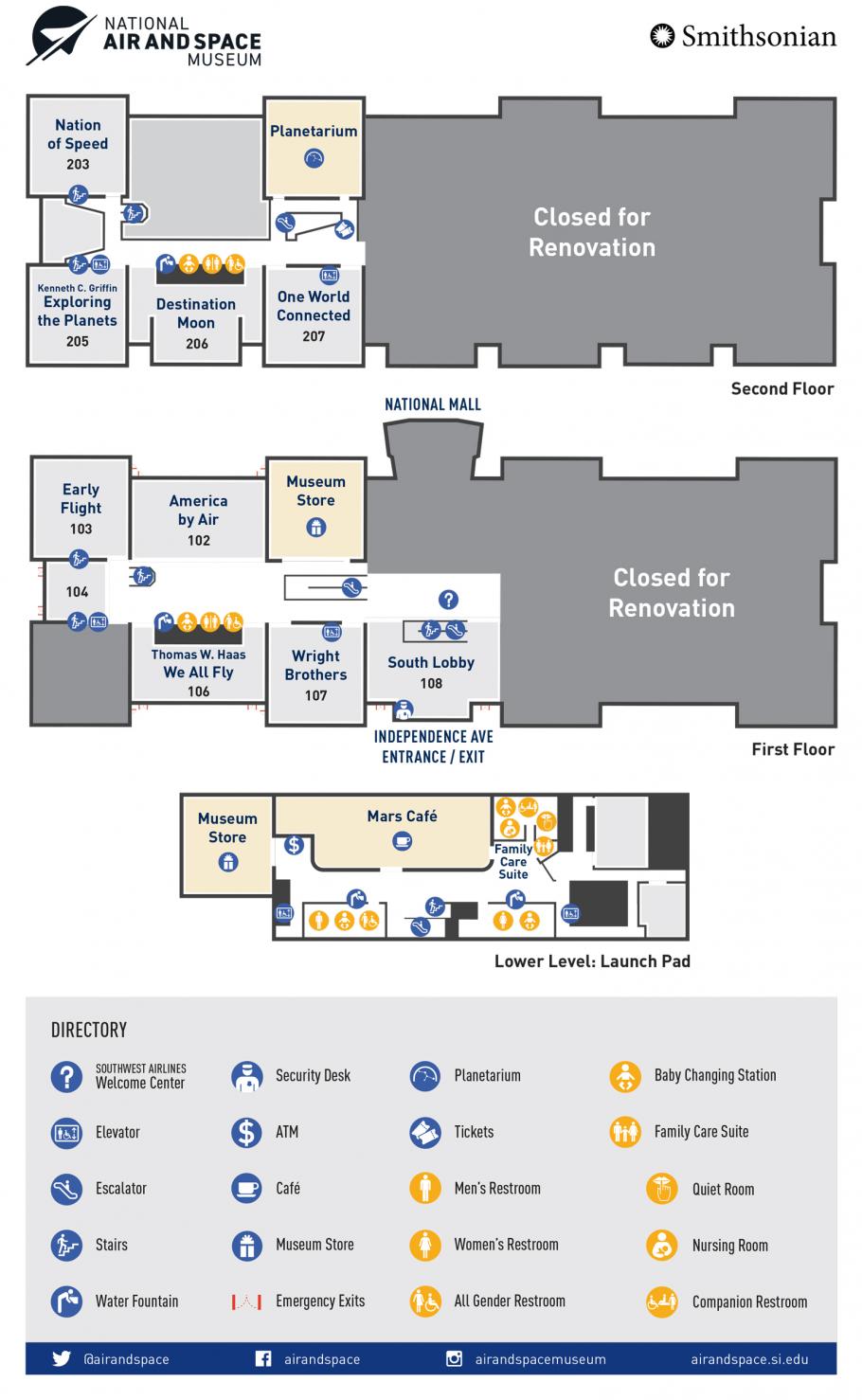
The National Air and Space Museum is undergoing a monumental multi-year renovation, which began in 2018. Transforming every visitor's experience, the Museum will use creative and dynamic techniques to engage visitors while they are at the Museum and after they leave.