
All Stories
Showing 21 - 30 of 263

December 18, 2024
A Beautiful Restored Biplane Represents a Future That Never Was
The Curtiss F9C-2 Sparrowhawk was a light 1930s biplane fighter aircraft that was designed to launch from the United States Navy airships USS Akron and Macon.

October 10, 2024
AirSpace Season 9 Episode 11: Flak-Bait, Ooh Ha Ha!
During WWII one plane survived more missions than any other in Europe. Named 'Flak-Bait,' this medium bomber was saved from the scrap heap after the war and immediately donated to the Smithsonian. However, public display and outdated restoration techniques have taken a toll on the plane.

September 23, 2024
The Birth of Military Aviation
The National Air and Space Museum’s World War I: The Birth of Military Aviation gallery will highlight the war's central role in defining the nature of military aviation and the remarkable experiences of World War I aviators.

September 23, 2024
Jumbo Jet
How the National Air and Space Museum acquired the Boeing 747 for America by Air exhibition.
September 12, 2024
AirSpace Season 9, Episode 9: Birds of a Feather
It's a bird? It's a plane? Its a guy pretending to be a bird?? We have a very odd aircraft in the collection.

August 09, 2024
The Martin K-III Kitten
When the K-III’s designer James Vernon Martin offered the diminutive aircraft to the Smithsonian Institution’s National Museum in 1924, he presented it as “the first aeroplane in the entire world to incorporate the retractable chassis.” The aircraft is a one-of-kind, experimental World War I era single-seat scout biplane.

August 07, 2024
What Happened to the Concordes?
These days, it takes seven hours to fly from New York to London, compared to under three hours flying at twice the speed of sound on the Concorde. When I started my internship at the National Air and Space Museum, I was determined to learn why.

July 31, 2024
Soaring Into History: Al Parker’s Record-Breaking Flight in the Sisu Sailplane
On July 31, 1964, Al Parker flew from Odessa, Texas, to Kimball, Nebraska, in the Sisu sailplane, which is on display at the Steven F. Udvar-Hazy Center. It was the first time anyone had flown a motorless aircraft more than 621 miles nonstop.
July 25, 2024
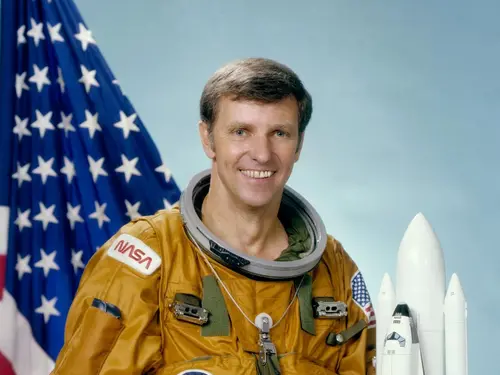
“General Joe”: Remembering Pilot and Astronaut Joe Engle
Maj. Gen. Joe Engle's experiences as a test pilot of both the X-15 aircraft and Space Shuttle orbiters Enterprise, Columbia, and Discovery made him the first person to ever fly two winged vehicles to space, amongst his many noteworthy achievements. The Museum was most honored to host him as the earliest Space Shuttle commander to attend the arrival ceremony of Discovery at the Steven F. Udvar-Hazy Center in 2012.

July 22, 2024
How An Airship Became a Flying Aircraft Carrier
It was envisioned that an entire squadron of rigid airships could act as a scouting fleet from 15,000 feet in the air, visually covering thousands of square miles each day. If each of those airships were able to launch and retrieve their own scouting airplanes, that range could be increased exponentially, far more than any naval vessel was capable of. They were essentially creating a flying aircraft carrier.