
Flying the F-15 Propelled Cesar Rodriguez to a Remarkable Combat Career
Sep 11, 2025
By Diane Tedeschi
A retired fighter pilot watches his jet roar through the sky one last time.
The distinctive, high-rpm whine of jet engines cut through the thick, humid air of an August afternoon as a few dozen people waited expectantly on the grass next to a concrete ramp. They had turned out to see the arrival of the National Air and Space Museum’s newest aircraft, an F-15C Eagle that had just flown into Washington Dulles International Airport in northern Virginia. Rolling along on a taxiway that connects the airport to the Museum’s Steven F. Udvar-Hazy Center, the jet emerged from behind a stand of trees, made a left turn, pulled onto the ramp, and shut down its two engines.
After a few minutes, the F-15’s pilot, who was delivering the jet from the Oregon Air National Guard, exited the cockpit and climbed to the ground. At that moment, a man wearing a perfectly tailored blue suit broke away from the crowd and welcomed the F-15 pilot with a hug. The embrace was a moving coda to a military career that had begun decades earlier for Cesar Rodriguez (call-sign Rico), a retired U.S. Air Force colonel who is distinguished by his three air-to-air victories in the Eagle (two in the 1991 Gulf War and one in Operation Allied Force in 1999).
Rodriguez’ presence at the fly-in was evidence of his historic connection to the Museum’s F-15C, serial number 85-0114. It was in this aircraft that he won the two Desert Storm engagements against Iraqi pilots—one flying a MiG-29 and the other a MiG‑23. After leaving the Air Force in 2006, Rodriguez spent 15 years in the aerospace industry before establishing the Splash 3 Foundation, a nonprofit that supports military veterans in the Tucson area. Rodriguez recently spoke with Air & Space Quarterly senior editor Diane Tedeschi.

During Operation Desert Storm, Rodriguez prepares for takeoff in the cockpit of an F-15C, serial number 85‑0114, which is now on display at the Steven F. Udvar-Hazy Center. The mark under Rodriguez’ name notes his air-to-air victory against a MiG-29.
ASQ: How did you become interested in aviation?
Rodriguez: Interestingly enough, that wasn’t my original passion coming out of high school or even my first couple of years in college. It was my roommate who challenged me to go with him to take all the aviation qualification tests that were offered at The Citadel our sophomore year. Then a couple of months after that, the Air Force reached out to me and said, “Hey, you scored high enough to make it to pilot training. We would like to be able to give you a two-year scholarship for the Air Force and then put you through the flight screening process.” And so the answer to all that was yes, yes, and yes.
In my junior year, I started learning how to fly a Cessna 172, and after a couple of sorties flying the aircraft, my instructor said: “Why don’t you just go ahead and land the airplane? Let me get out.” Needless to say, I was a bit shocked because that would’ve been the first time that I had ever flown solo. He got out, and I requested clearance from the tower for takeoff, and I took off and flew around the local area there in Charleston, South Carolina. At that point, I just said, “Okay, this is what I want to do.”
You had settled on a career in the military?
That’s correct. My father was a career Army officer, and we traveled all around the United States and throughout South and Central America. He did tours in Vietnam, Greenland, and in other places. As an Army brat, the whole military experience was something that attracted me, so that was a key criterion in selecting The Citadel as where I wanted to go to school.
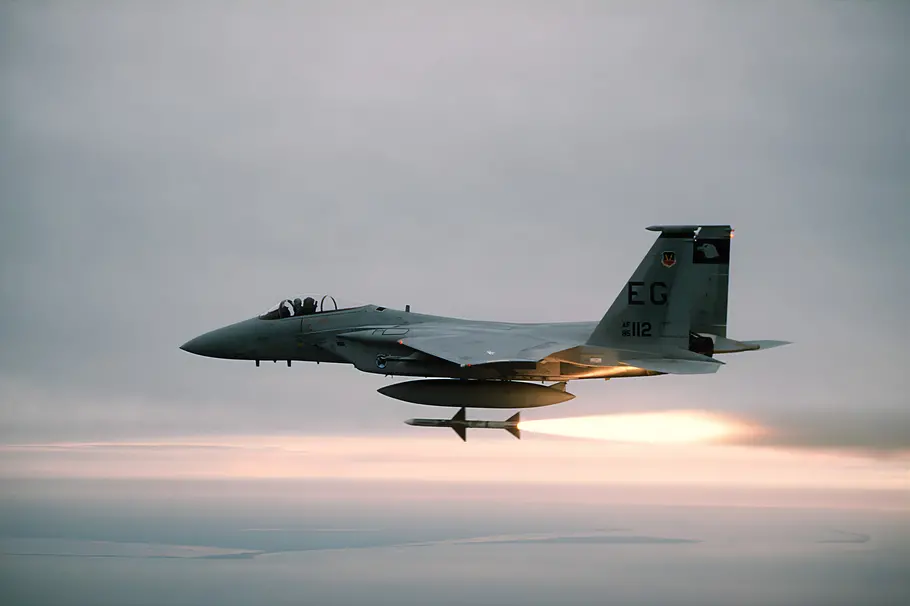
For many years, the twin-engine McDonnell Douglas F-15 was the U.S. Air Force’s frontline air superiority fighter.
After you had committed to becoming an Air Force pilot, were you drawn toward any particular aircraft or any particular role? Or were you just letting the chips fall where they may?
I would say the latter. I think I started pilot training with the mindset: Let’s earn our wings, let’s do that first. What I learned very quickly in pilot training was that everybody in the room (70-plus young lieutenants and junior captains) was very type A, very focused, very driven. Some folks had thought about flying since the day they started walking. Then there were others were like me, late bloomers. Once I realized where I was at and who was around me, I very quickly started to change my approach. Not only was I going to earn my wings, but I wanted to be a fighter pilot too.
The first phase of the program, the T-37, was very humbling because—I’ll be honest with you—I probably on many occasions thought I was going to wash out. Flying felt natural, but everything else associated with flying—the cross check, the communication, the stick and rudder, wearing 80 pounds of gear, all that stuff—didn’t feel natural at the time. So training in T-37s was a rough period for me. My check rides weren’t as sterling as some of my classmates, and I was starting to wonder if I’d made the right career choice.
But then I transitioned to the T-38. My first instructor was a captain (call-sign Wheels), a former F-4 pilot. Wheels was the first one who sat me down and said, “What do you really want to do?” When I told him I wanted to be a fighter pilot, his first response was: “Well, you’re not good enough at this stage, but here’s what I am ready to do with you and for you.” That was my first true experience with a mentor figure. Wheels helped me change my attitude and refocus my energies to work my way into the running to be a fighter pilot. What Wheels taught me was phenomenal, and it got me to the point where I could compete to get a fighter. But obviously he also had other students, so I couldn’t take all his time.

After your training in the T-38, you got assigned to the A-10 Warthog, which is not a fighter. How did you feel about the Hog?
Well, I was totally excited. Our assignment-drop system was old school. There were five or six aircraft on the wall, and then they called your name, and you went up and pulled an airplane off the wall and that became your assignment. There was only one F-15 on the board. There were no F-16s. There was one A-10. There were several T-33s and an F-111, so I was very excited that I got to pick the A-10. As I learned more about the aircraft, I got to appreciate what the A-10 brought to the mission of close air support and search-and-rescue. I saw firsthand that the A-10 was built from the standpoint of being able to provide an offensive response to the enemy on the ground—in close proximity to friendlies or protected sites. Flying it was a blast.
I’ve been to quite a few airshows over the years, and I’ve seen a lot of flight demonstrations: F-16, F-15, F-14, B-1. Probably the most memorable demo I’ve ever seen is the A-10. This aircraft’s tight turn radius is breathtaking.
The airshow world wants to make your experience memorable as a ground participant. And the fact that the A-10 can do its entire routine within visual distance of show center does indeed make it memorable. Airshows also demonstrate the maneuverability you would need when flying the A-10 in combat, whether it’s using the gun or launching a rocket on a target that’s probably in very close proximity to friendly forces. When you’re watching the A-10 maneuver at an airshow, there are times that the pilot is literally on the edges of the stall warning. They are maxing out the jet. When that happens, they have to unload and regain energy.
Even though you liked the A-10, I’m guessing you didn’t forget about the F-15.
Yeah, I was still impressed by the F-15’s pure raw power: You could see it and hear it on the ground as you watched an F-15 taxi and then take off. I saw that at an airshow when I was in pilot training. I also felt that the F-15 was very what I call stick-and-rudder friendly. Even though a fly-by-wire feature was built into the F-15, the primary operating actions of the pilot were still via stick and rudder. An F-15 pilot had full stick-and-rudder authority, which meant you could over-G the jet. At the same time, you could use that raw power and that big, huge wing and then apply appropriate stick-and-rudder controls to make the airplane literally dance in the sky and do things that made people say: “Whoa, how did that happen?” And now you could transition from a defensive position to an offensive position. I felt that flying the F-15 would expand on the stick-and-rudder foundation I had built in the A-10.

F-15Cs provided protection for Air Force B-2s during Operation Allied Force in 1999.
What would you say are the most important abilities a fighter pilot should have?
I’m going to give you an answer through the lens of somebody who was a fighter pilot for 27 years. I think the first and foremost quality a fighter pilot needs is a solid foundation at home and in the community. If I had been distracted with something going on at home or in my community, I would not have been successful. So I tell people, your passion to be a fighter pilot is awesome, but you should also think about your passion to be a solid member of your family and community. Those two items alone will bring so much peace when chaos—which is what combat is all about—surrounds you.
Flying a fighter jet in combat is not a 9-to-5 job. How do you handle the lack of sleep and still be able to execute in the air?
Well, there are certain battle rhythms that help you align your circadian rhythm to the ops tempo, and I always tell people that when you got your chance to take a nap, you took it. When I was on alert, the only thing that stayed in the cockpit was my helmet, but the rest of my uniform—my G-suit, harness, and everything else—I slept with, and I would just go in and power nap. Much like you see truck drivers taking power naps on the side of the road, that’s the approach we all took. The only time you knew you were going back to your room was when you saw the schedule after you landed that day, and you saw that you weren’t on alert and your next time to be in the air was six or eight hours later. For me, though, the adrenaline rush of each of my air-to-air kills required more than power naps. After the first one, I was scheduled for a six-hour break. When I got to my room, I took a shower and laid down, but I just tossed and turned. I did that for two days without sleeping, and I finally had to talk to the flight doc to say: “Listen, I need to come off the schedule for at least one solid eight-hour period, and I need some kind of pill to help me sleep.” And that did work.

An underside view of the Eagle shows one reason it was such a formidable fighter: It could carry a variety of air-to-air missiles.
After your first kill during Desert Storm, you and your wingman were returning to Tabuk, your base in Saudi Arabia. You did a low approach with afterburner before sweeping up into an aileron roll. I’m guessing it was an expression of jubilation: “Hey, we got our first kill.” Was it also for the benefit of the airmen working at the base?
The guys in my squadron who had flown at night on day two scored an air victory, and they did an aileron roll. So my wingman and I felt like we needed to do the same thing. The entire staff at Tabuk was listening for the airplanes to come home, and they might not hear you as you’re doing your low approach. But they’re definitely going to hear you when you slap on the burners, pick the nose up, do an aileron roll, and then pitch up and come in for the landing. They will see that—the people at the hospital, the folks at the chapel, the folks at the chow hall. Everyone is now aware that, hey, we have achieved a victory.

Rodriguez and Colonel Adam “Axe” Gaudinski—commander of the Oregon Air National Guard’s 173rd Fighter Wing—watch as Rodriguez’ name is revealed on the aircraft’s nose.
The F-15 in which you scored two of your air-to-air kills is now part of the collection of the National Air and Space Museum. What are your thoughts?
If the airplane I flew is in a museum, then I’m old, which is okay. I don’t have a problem with getting old.
Well, it means you survived all that combat. That’s one way to look at it.
That’s right, yes. I always tell people that now when I see 85-0114 there at the Smithsonian, I’m not going to focus on all the sweat and tears from my combat deployments. But I am going to see the fingerprints of everybody who helped put that airplane in the air for every mission. I’m going to see the fingerprints of people who came out to reload the airplane for combat turns with real weapons. I’m going to see the fingerprints of the young airmen who came out to the flight line to refuel her to get her ready for the next turn. I’m going to see the fingerprints of my crew chief and the many crew chiefs who took care of 114. And then I’m going to see the fingerprints of all the pilots who flew her, took her through the ringer, over G-ed her, blew a tire, whatever. All the things that happened with a jet that has survived 20 years of real hard flying, I’m going to see all those fingerprints on the airplane, and I’m going to say thank you.
An online story by Michael W. Hankins, a curator in the National Air and Space Museum’s aeronautics department, provides a detailed account of the two aerial victories scored by Cesar "Rico" Rodriguez in the Museum’s new F-15C Eagle.

This article, originally titled "Rico and the F-15," is from the Fall 2025 issue of Air & Space Quarterly, the National Air and Space Museum's signature magazine that explores topics in aviation and space, from the earliest moments of flight to today. Explore the full issue.
Want to receive ad-free hard copies of Air & Space Quarterly? Join the Museum's National Air and Space Society to subscribe.
Related Topics
You may also like

 Exhibition
 Story
Story
 Story
Story

We rely on the generous support of donors, sponsors, members, and other benefactors to share the history and impact of aviation and spaceflight, educate the public, and inspire future generations. With your help, we can continue to preserve and safeguard the world’s most comprehensive collection of artifacts representing the great achievements of flight and space exploration.
Support the Museum
We rely on the generous support of donors, sponsors, members, and other benefactors to share the history and impact of aviation and spaceflight, educate the public, and inspire future generations. With your help, we can continue to preserve and safeguard the world’s most comprehensive collection of artifacts representing the great achievements of flight and space exploration.