Reserve Free Passes Membership
Visit
  • Visit

  • National Air and Space Museum in DC
  • Udvar-Hazy Center in VA
  • Plan a Field Trip
  • Plan a Group Visit
View of the Steven F. Udvar-Hazy Center tower at sunset

One museum, two locations

Visit us in Washington, DC and Chantilly, VA to explore hundreds of the world’s most significant objects in aviation and space history. Free timed-entry passes are required for the Museum in DC.

What's On
  • What's On

  • Events
  • Exhibitions
  • IMAX and Planetarium
Apollo 11: Buzz Aldrin on the Moon

At the museum and online

Discover our exhibitions and participate in programs both in person or virtually.

Explore
  • Explore

  • Stories
  • Topics
  • Collections
  • On Demand
  • For Researchers
space shuttle launch

Dive deep into air and space

Browse our collections, stories, research, and on demand content.

Learn
  • Learn

  • Programs
  • Learning Resources
  • Plan a Field Trip
  • Professional Development
Women in Aviation and Space Family Day

For teachers and parents

Bring the Air and Space Museum to your learners, wherever you are.

Give
  • Give

  • Donate
  • Become a Member
  • Wall of Honor
  • Ways to Give
  • Host an Event
Bob Hoover Gives an Air Show Performance

Be the spark

Your support will help fund exhibitions, educational programming, and preservation efforts.

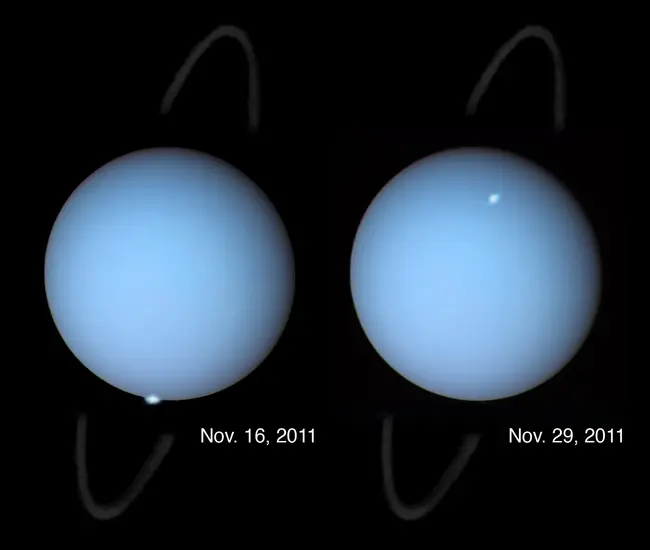
Aurorae on Uranus

  1. Breadcrumb Home
  2. Multimedia Gallery
  3. Aurorae On Uranus
  • Two images of Saturn next to each other. The image on the left taken 13 days before the one on the right. A spot of light is seen on the bottom of Uranus in the left image and moves toward the top of Uranus in the right image.
    Download Image

    Aurorae on Uranus
    These are among the first clear images, taken from the distance of Earth, to show aurorae on the planet Uranus. Aurorae are produced when high-energy particles from the Sun cascade along magnetic field lines into a planet's upper atmosphere. This causes the planet's atmospheric gasses to fluoresce. The ultraviolet images were taken at the time of heightened solar activity in November 2011 that successively buffeted the Earth, Jupiter, and Uranus with a gusher of charged particles from the Sun. Because Uranus' magnetic field is inclined 59 degrees to its spin axis, the auroral spots appear far from the planet's north and south poles. This composite image combines 2011 Hubble observations of the aurorae in visible and ultraviolet light, 1986 Voyager 2 photos of the cyan disk of Uranus as seen in visible light, and 2011 Gemini Observatory observations of the faint ring system as seen in infrared light.

    NASA, ESA, and L. Lamy (Observatory of Paris, CNRS, CNES)

  • Two images of Saturn next to each other. The image on the left taken 13 days before the one on the right. A spot of light is seen on the bottom of Uranus in the left image and moves toward the top of Uranus in the right image.

ID#:

STscl-PRC2012-21

Source:

NASA, ESA, and L. Lamy (Observatory of Paris, CNRS, CNES)

Copyright:

NASA, ESA, and L. Lamy (Observatory of Paris, CNRS, CNES)

Rights Usage:

Contact NASA, ESA, and L. Lamy (Observatory of Paris, CNRS, CNES)

Terms of Use:

Smithsonian Terms of Use

Admission is always free.
Open daily 10:00 am – 5:30 pm

National Air and Space Museum

National Air and Space Museum 650 Jefferson Drive SW
Washington, DC

202-633-2214

Free Timed-Entry Passes Required

Steven F. Udvar-Hazy Center

Steven F. Udvar-Hazy Center 14390 Air and Space Museum Parkway
Chantilly, VA 20151

703-572-4118

  • About
  • Become a Member
  • Newsroom
  • Host an Event
  • Get Involved
  • Contact
  • Privacy
  • Terms of Use
  • Accessibility