

Bessie Coleman

June 15, 1921
Bessie Coleman, First African American Woman to Earn a Pilot's License
In the 1920s, getting a pilot's license as a Black woman in the United States was impossible; so Coleman moved to France to get her flying certification.
On June 15, 1921, Coleman achieved her goal—making history as the first African American woman to earn a pilot's license.
Read More About Coleman's Life Listen to a Podcast Episode About Coleman
Coleman's Path to Earning Her Pilot's License
The Great Migration
During the Great Migration, six million Black Americans moved from the American South, further north, in search of better opportunities. One of those people was Bessie Coleman.
Coleman was born Texas in 1892. She followed her siblings north to Chicago.
Coleman's brother served in France during World War I. He taunted her with stories of French women flyers. She replied, “That’s it… You just called it for me!” She was determined to learn to fly.
As a manicurist, she also heard stories of World War I pilots that inspired her.
Coleman even won a contest that declared her the best manicurist in Black Chicago.
Work as a manicurist or beautician was an important source of financial freedom and opportunity for many African American women in the early 1900s. Coleman's work allowed her to save money for her training.

To Earn Her Pilot's License, She Had to Leave the Country
White pilots in the United States refused to train Bessie Coleman due to her race and gender.
Robert Abbot, publisher of the Black newspaper the Chicago Defender, advised Coleman to seek training in France where Black people had opportunities. So Coleman learned French and prepared to travel.
She trained at the well-respected Caudron Brothers School of Aviation. She earned her license in just seven months.
Coleman quickly determined she needed more training to safely perform barnstorming stunts and someday operate her own flight school. She returned to Europe in early 1922 and trained in France and Berlin, Germany. In Germany, she flew with military aces. When she returned again to the United States, Black and white newspaper reporters greeted her in New York City and hailed her accomplishments.

Barnstorming and Working Towards a New Goal
On September 3, 1922, Bessie Coleman made the first public flight by a Black woman in the United States.
Ultimately, she began barnstorming—one of the few jobs in aviation at this time. A popular style of flying in the 1920s, barnstormers flew tricks and stunts for eager crowds.
In an era of intense racial prejudice, Coleman would only perform in exhibition shows for desegregated crowds.
Coleman's next goal was to open a flight school.
In Addition to Barnstorming, Bessie Coleman Was ...
A Popular Speaker
Coleman's talks, featuring photographs and film of her flights with German pilots, drew large audiences and paid more than her flying.
Coleman was offered a leading role in a film. She accepted the part. However, when she discovered that the movie began with her appearing in rags, Coleman announced “No Uncle Tom stuff for me!” and turned down the role. She was not offered another.
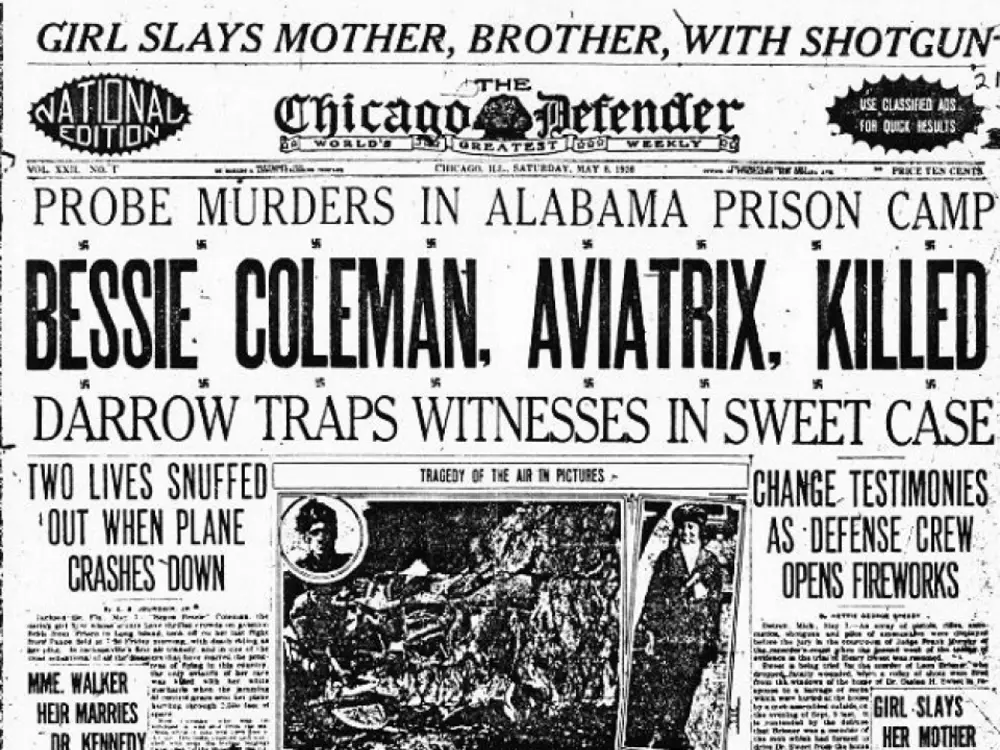
April 30, 1926
Tragedy Strikes: Bessie Coleman Killed in the Air
Preparing for an upcoming performance, Coleman and her mechanic, William Wills, went up for a practice flight. Coleman was surveying the ground for a suitable parachute landing site, so she did not buckle her seat belt.
The biplane suddenly went into a nosedive, tailspin, and flipped over. Coleman was thrown from the aircraft and killed. Wills crashed with the plane and was also killed.
Coleman was deeply mourned in the African American community. Her body lay in state in both Florida and Chicago. Renowned activist and journalist Ida B. Wells delivered her eulogy.

Bessie Coleman's Legacy Continues to Make an Impact
While Coleman did not achieve her dream of opening a flying school, her brief career inspired many others.
William Powell organized the Bessie Coleman Aero Club (pictured in the background) and sponsored the first all-Black air show.
Chicago's Challenger Air Pilots Association fought for opportunities for Black pilots.
Bessie Coleman Cleared The Runway For Pilots Who Followed Her


Still Curious? Enjoy These Videos About Coleman

The youngest learners will enjoy this originally illustrated story about Bessie Coleman, followed by a craft to make a small biplane.
Duration 12 minutes

Ideal for middle schoolers, author of a children's book about Bessie Coleman (and Charles Lindbergh's daughter) talks about Coleman.
Duration 1 minute

Adults will enjoy this panel discussion of historians, scientists, and pilots celebrating Coleman’s achievement, boundary-breaking life, and lasting legacy.
Duration 52 minutes