Reserve Free Passes Membership
Visit
  • Visit

  • National Air and Space Museum in DC
  • Udvar-Hazy Center in VA
  • Plan a Field Trip
  • Plan a Group Visit
View of the Steven F. Udvar-Hazy Center tower at sunset

One museum, two locations

Visit us in Washington, DC and Chantilly, VA to explore hundreds of the world’s most significant objects in aviation and space history. Free timed-entry passes are required for the Museum in DC.

What's On
  • What's On

  • Events
  • Exhibitions
  • IMAX and Planetarium
Apollo 11: Buzz Aldrin on the Moon

At the museum and online

Discover our exhibitions and participate in programs both in person or virtually.

Explore
  • Explore

  • Stories
  • Topics
  • Collections
  • On Demand
  • For Researchers
space shuttle launch

Dive deep into air and space

Browse our collections, stories, research, and on demand content.

Learn
  • Learn

  • Programs
  • Learning Resources
  • Plan a Field Trip
  • Professional Development
Women in Aviation and Space Family Day

For teachers and parents

Bring the Air and Space Museum to your learners, wherever you are.

Give
  • Give

  • Donate
  • Become a Member
  • Wall of Honor
  • Ways to Give
  • Host an Event
Bob Hoover Gives an Air Show Performance

Be the spark

Your support will help fund exhibitions, educational programming, and preservation efforts.

Saturn’s Bright Satellites

  1. Breadcrumb Home
  2. Multimedia Gallery
  3. Saturn’s Bright Satellites
  • Three moons against a dark background. The moon in the middle appears to be the largest while the moons to the left and right are much smaller looking.
    Download Image

    The Cassini spacecraft observes three of Saturn's moons set against the darkened night side of the planet. Saturn is present on the left this image but is too dark to see. Rhea (1,528 kilometers, or 949 miles across) is closest to Cassini here and appears largest at the center of the image. Enceladus (504 kilometers, or 313 miles across) is to the right of Rhea. Dione (1,123 kilometers, or 698 miles across) is to the left of Rhea, partly obscured by Saturn.
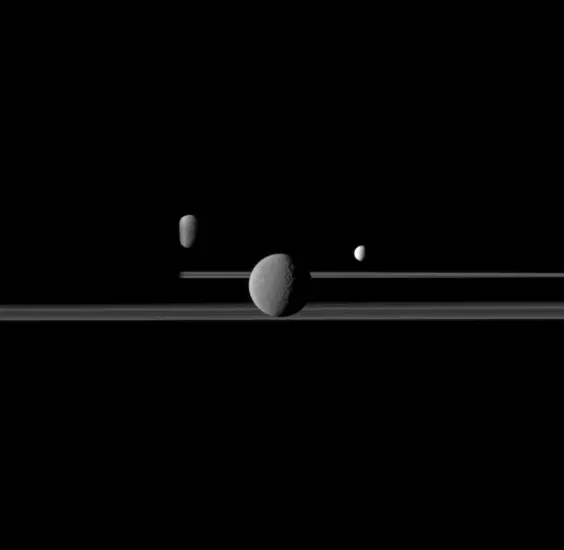
  • Three moons against a dark background. The moon in the middle appears to be the largest while the moons to the left and right are much smaller looking.

ID#:

NASA-PIA12771

Source:

NASA/JPL/Space Science Institute

Copyright:

NASA Jet Propulsion Laboratory

Rights Usage:

Contact NASA Jet Propulsion Laboratory

Terms of Use:

Smithsonian Terms of Use

Admission is always free.
Open daily 10:00 am – 5:30 pm

National Air and Space Museum

National Air and Space Museum 650 Jefferson Drive SW
Washington, DC

202-633-2214

Free Timed-Entry Passes Required

Steven F. Udvar-Hazy Center

Steven F. Udvar-Hazy Center 14390 Air and Space Museum Parkway
Chantilly, VA 20151

703-572-4118

  • About
  • Become a Member
  • Newsroom
  • Host an Event
  • Get Involved
  • Contact
  • Privacy
  • Terms of Use
  • Accessibility