Reserve Free Passes Membership
Visit
  • Visit

  • National Air and Space Museum in DC
  • Udvar-Hazy Center in VA
  • Plan a Field Trip
  • Plan a Group Visit
View of the Steven F. Udvar-Hazy Center tower at sunset

One museum, two locations

Visit us in Washington, DC and Chantilly, VA to explore hundreds of the world’s most significant objects in aviation and space history. Free timed-entry passes are required for the Museum in DC.

What's On
  • What's On

  • Events
  • Exhibitions
  • IMAX and Planetarium
Apollo 11: Buzz Aldrin on the Moon

At the museum and online

Discover our exhibitions and participate in programs both in person or virtually.

Explore
  • Explore

  • Stories
  • Topics
  • Collections
  • On Demand
  • For Researchers
space shuttle launch

Dive deep into air and space

Browse our collections, stories, research, and on demand content.

Learn
  • Learn

  • Programs
  • Learning Resources
  • Plan a Field Trip
  • Professional Development
Women in Aviation and Space Family Day

For teachers and parents

Bring the Air and Space Museum to your learners, wherever you are.

Give
  • Give

  • Donate
  • Become a Member
  • Wall of Honor
  • Ways to Give
  • Host an Event
Bob Hoover Gives an Air Show Performance

Be the spark

Your support will help fund exhibitions, educational programming, and preservation efforts.

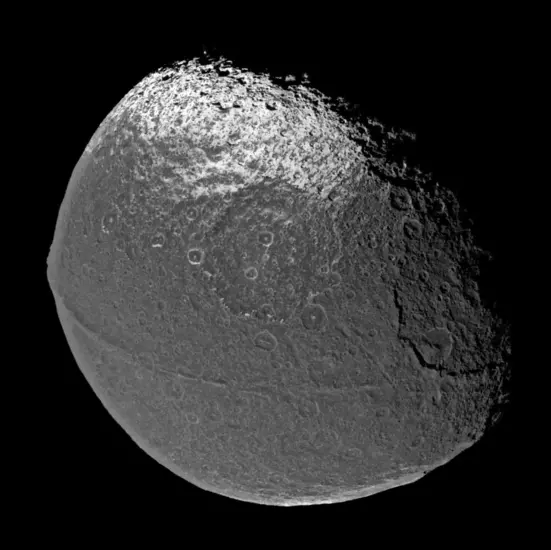
Saturn's Moon Iapetus

  1. Breadcrumb Home
  2. Multimedia Gallery
  3. Saturn's Moon Iapetus
  • A grey circular shape with a textured exterior.
    Download Image

    Original caption from JPL: 

    On New Year's Eve 2004, Cassini flew past Saturn's intriguing moon Iapetus, capturing the four visible light images that were put together to form this global view.

    The scene is dominated by a dark, heavily-cratered region, called Cassini Regio, that covers nearly an entire hemisphere of Iapetus. Iapetus is 1,436 kilometers (892 miles) across. The view is centered on the moon's equator and on roughly 90 degrees west longitude -- a location that always faces the direction of Iapetus's orbital motion around Saturn.

    Within Cassini Regio, and especially near the equator, dark deposits with a visual reflectivity of only about 4 percent coat nearly everything with remarkable uniformity. However, at latitudes of about 40 degrees, the surface transitions to a much brighter, icy terrain near the pole where the brightest icy materials have reflectivity over 60 percent. However, this region is not uniform: Close inspection reveals that the surface is stained by crudely north-south trending wispy streaks of darker material, typically a few kilometers wide and sometimes tens of kilometers long.

    An ancient, 400-kilometer wide (250 miles) impact basin appears just above the center of the disc. The basin is heavily overprinted by more recent, smaller impact craters. The basin rim is delineated by steep scarps that descend to the basin floor. Many of these scarps, as well as walls of nearby craters, appear bright, probably due to exposed outcrops of relatively clean ice. Particularly at mid-latitudes, the brightest scarp exposures appear to face away from the equator (i.e. toward the pole). Often, the opposite south-facing scarps are stained with the lower-brightness material.

    The most unique, and perhaps most remarkable feature discovered on Iapetus in Cassini images is a topographic ridge that coincides almost exactly with the geographic equator. The ridge is conspicuous in the picture as an approximately 20-kilometer wide (12 miles) band that extends from the western (left) side of the disc almost to the day/night boundary on the right. On the left horizon, the peak of the ridge reaches at least 13 kilometers (8 miles) above the surrounding terrain. Along the roughly 1,300 kilometer (800 mile) length over which it can be traced in this picture, it remains almost exactly parallel to the equator within a couple of degrees. The physical origin of the ridge has yet to be explained. It is not yet clear whether the ridge is a mountain belt that has folded upward, or an extensional crack in the surface through which material from inside Iapetus erupted onto the surface and accumulated locally, forming the ridge.

    The origin of Cassini Regio is a long-standing debate among scientists. One theory proposes that its dark material may have erupted onto Iapetus's icy surface from the interior. Another theory holds that the dark material represented accumulated debris ejected by impact events on dark, outer satellites of Saturn. Details of this Cassini image mosaic do not definitively rule out either of the theories. However, they do provide important new insights and constraints.

    The uniform appearance of the dark materials at the equator, the apparent thinning and spottiness of the dark materials at progressively higher latitudes and dark wispy streaks near the distal margin of Cassini Regio strongly suggest that dark material was emplaced as a coating. One of the important new results is that no clear evidence can be found that erupted fluids have resurfaced Cassini Regio. The high density of impact craters argues that the terrain underlying the dark coating is relatively ancient and has not been eradicated by its emplacement. Thus, Cassini Regio may have had its origin in plume-style eruptions in which dark particulate materials accumulated on the surface as fallout, perhaps in conjunction with the creation of the equatorial ridge. On the other hand, the dark deposits in Cassini Regio may be a surface coating consistent with, and perhaps more simply explained by, the fall of dark materials from outside.

    The view has been oriented so that the north pole is toward the top of the picture.

    Cassini acquired the images in this mosaic with its narrow angle camera on Dec. 31, 2004, at a distance of about 172,400 kilometers (107,124 miles) from Iapetus and at a Sun-Iapetus-spacecraft, or phase, angle of 50 degrees. The image scale is 1 kilometer (0.6 miles) per pixel. The image has been contrast enhanced to aid visibility of surface features.

    The Cassini-Huygens mission is a cooperative project of NASA, the European Space Agency and the Italian Space Agency. The Jet Propulsion Laboratory, a division of the California Institute of Technology in Pasadena, manages the mission for NASA's Science Mission Directorate, Washington, D.C. The Cassini orbiter and its two onboard cameras were designed, developed and assembled at JPL. The imaging team is based at the Space Science Institute, Boulder, Colo.

    For more information about the Cassini-Huygens mission visit http://saturn.jpl.nasa.gov. For images visit the Cassini imaging team home page http://ciclops.org.

  • A grey circular shape with a textured exterior.

Copyright/Owner:

NASA Jet Propulsion Laboratory

Rights Usage:

Contact NASA Jet Propulsion Laboratory

Terms of Use:

Smithsonian Terms of Use

Admission is always free.
Open daily 10:00 am – 5:30 pm

National Air and Space Museum

National Air and Space Museum 650 Jefferson Drive SW
Washington, DC

202-633-2214

Free Timed-Entry Passes Required

Steven F. Udvar-Hazy Center

Steven F. Udvar-Hazy Center 14390 Air and Space Museum Parkway
Chantilly, VA 20151

703-572-4118

  • About
  • Become a Member
  • Newsroom
  • Host an Event
  • Get Involved
  • Contact
  • Privacy
  • Terms of Use
  • Accessibility