
Can Two Planets Orbit Each Other?
Sep 29, 2025
Planets orbit the Sun, and moons orbit planets and other small planetary bodies, but can two planets orbit each other? The short answer to this question is yes, two planets could orbit each other in what is typically called a double planet or a binary planet system. However, there is some debate amongst scientists about when a system should be called a planet with a moon vs. a binary planet system.
The International Astronomical Union (IAU) is the organization that officially demoted Pluto to dwarf planet status. The IAU is also the keeper of definitions and the namers of space things. However, the IAU doesn’t have a definition of binary planet system. Some scientists have proposed that any system in which both bodies meet all the criteria for the IAU’s definition of a planet independently should be considered a double planet system. According to the IAU, a planet is a celestial body that: (1) is in orbit around the Sun, (2) is massive enough to be nearly round in shape, and (3) has cleared out any other large bodies from its orbit. Learn more about what makes a moon a moon.
In the case of the Earth-Moon system, using the IAU’s definition of a planet, it could be considered a double planet system. Alternatively, if the mass of both bodies is similar, then they could be considered a double planet system. But how similar do the two masses need to be for this definition? The Earth is only ~81 times more massive than the Moon while the moons of Mars, Jupiter, Saturn, Uranus, and Neptune all have masses over 4000 times less than the planet each of them orbit. In this context, the masses of the Earth and Moon are very similar and, again, some scientists would say that we are living on a double planet.
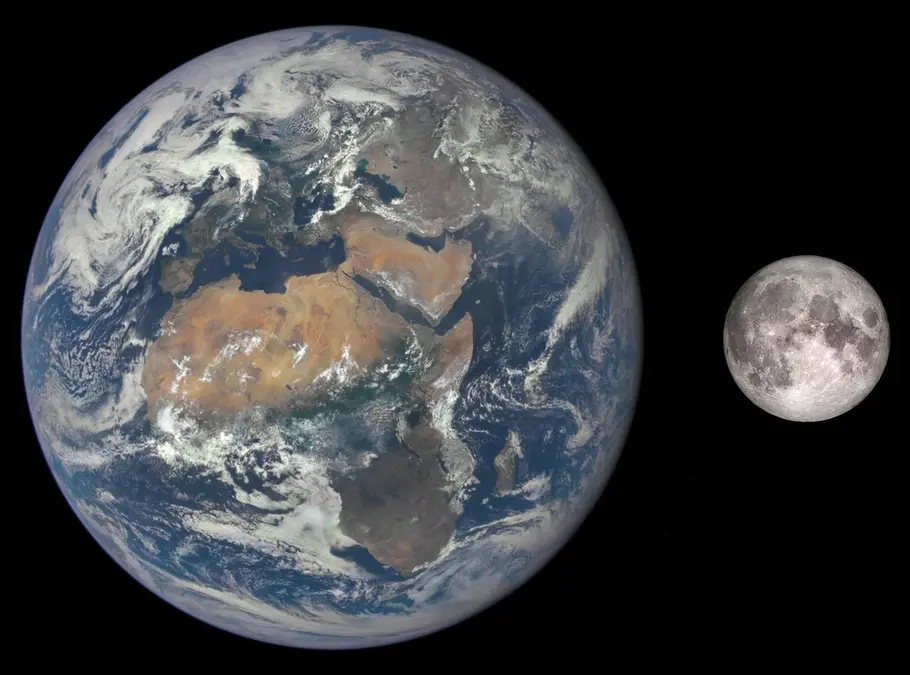
So why don’t we hear people calling the Earth-Moon system a double planet? This is because most scientists agree that a double planet system must have a barycenter located outside of both bodies. A barycenter is the shared center of mass of two or more bodies that orbit around each other in space, similar to the balancing point on a scale. For most moons in the solar system, the barycenter is located inside of the planet being orbited, so the barycenter for the Earth-Moon system is inside the Earth! However, when two bodies are close enough in mass, the barycenter will be at some point in space between the two. An example of this is the orbit of Jupiter around the Sun where the barycenter is located just outside of the Sun’s surface.

While we don’t see any double planets in our solar system today, the dwarf planet Pluto is only ~8 times more massive than its largest moon Charon. Due to their similar size, these two bodies orbit around a barycenter outside of Pluto which makes them a binary system, but not a binary planet. Pluto and Charon make a binary dwarf planet system. Within the solar system we also see pairs of roughly equal mass asteroids orbiting each other that are sometimes referred to as double minor planets, like asteroid (90) Antiope. Interestingly, the term ‘binary asteroid’ is often used for any asteroid with a satellite, so it doesn’t always mean that the two have similar in size.

Related Topics
You may also like


We rely on the generous support of donors, sponsors, members, and other benefactors to share the history and impact of aviation and spaceflight, educate the public, and inspire future generations. With your help, we can continue to preserve and safeguard the world’s most comprehensive collection of artifacts representing the great achievements of flight and space exploration.
Support the Museum
We rely on the generous support of donors, sponsors, members, and other benefactors to share the history and impact of aviation and spaceflight, educate the public, and inspire future generations. With your help, we can continue to preserve and safeguard the world’s most comprehensive collection of artifacts representing the great achievements of flight and space exploration.