
Do Other Planets Have Earthquakes and Volcanoes?
Aug 12, 2025
Yes! Many other planets and planetary bodies (I mean moons) experience these geological phenomena. In some cases, we have been able to directly measure earthquakes and see volcanoes erupting.
Earthquakes
We have been able to directly measure quakes on the Moon and Mars and refer to them as moonquakes and marsquakes. The first other-planetary-body-quakes were measured during the Apollo program as part of their Apollo Lunar Surface Experiment Packages (ALSEP). On Apollo 14 and 16 there was an Active Seismic Experiment, meaning the instrument was able to set off its own explosions to measure how the seismic energy traveled through the subsurface. On Apollo 11, 12, and 15 there were Passive Seismic Experiments that “listened” for vibrations caused by natural phenomena, like the movement of the lunar interior or impacts from meteoroids. The purpose of these seismic experiments was to determine (1) the internal structure (meaning the thickness of the core, mantle and crust) and composition of the Moon, (2) the forces deforming the Moon, and (3) the number of meteoroids hitting the lunar surface.
These data have been very important for informing our understanding of the Moon. We know there are three internal layers: a crust, a mantle and a metal-rich core. In particular, a reanalysis of these seismic data in 2011 showed that the Moon may have a solid inner core and a fluid outer core. The exact composition and degree of melt in the lunar interior can reveal more details about the lunar formation process and the early evolution of the Earth-Moon system.
NASA has also put a seismometer (named Seismic Experiment for Interior Structure, or SEIS) on Mars as part of the NASA Insight mission, landing there in November of 2018. During the course of its mission, Insight measured marsquakes caused by impact events, as well as motions in the planet’s interior caused by movement of magma or shrinking of the planet. In total, the instrument measured 1,319 marsquakes. The largest marsquake was a magnitude 5, which occurred in May 2022. You can actually “listen” to the marsquake. A magnitude 5 earthquake is considered a “light earthquake” by the United States Geological Survey and typically results in some property damage. Almost all the large marsquakes originated in a region called Cerberus Fossae, which is associated with relatively fresh lava flows.

Volcanoes
We see volcanoes of various shapes and sizes on the solid surfaces of most planetary bodies. They are everywhere. Mercury. Venus. Earth. Moon. Mars. Ceres. Europa. Ganymede. Enceladus. Titan. Triton. Miranda. Arial. Pluto. Charon. All these planetary bodies are interpreted to have volcanic landforms, typically in the form of volcanoes or volcanic flows.
Volcanoes are dome-shaped landforms that are built up of lava by successive eruptions. The steeper the volcano slopes, the stickier the erupting lava (be it rock or ice). The magma associated with volcanoes on icy moon is liquid water, rather than molten rock, and we call the process cryo-volcanism, rather than volcanism. Volcanoes are not the only features that indicate volcanic activity. We can look for lava flows, similar to what we see on the islands of Hawai’i, or pits, called calderas, that are places where lava erupts from below the surface. Sometimes calderas can be found on the tops of volcanoes, but not always.

Not only is there evidence for volcanism across the solar system, but there is also evidence that a few planetary bodies (other than Earth) are volcanically active today: Io and Venus! What do I mean by “active”, you ask? That means that we believe volcanic eruptions have occurred since we started observing those surfaces with satellites.
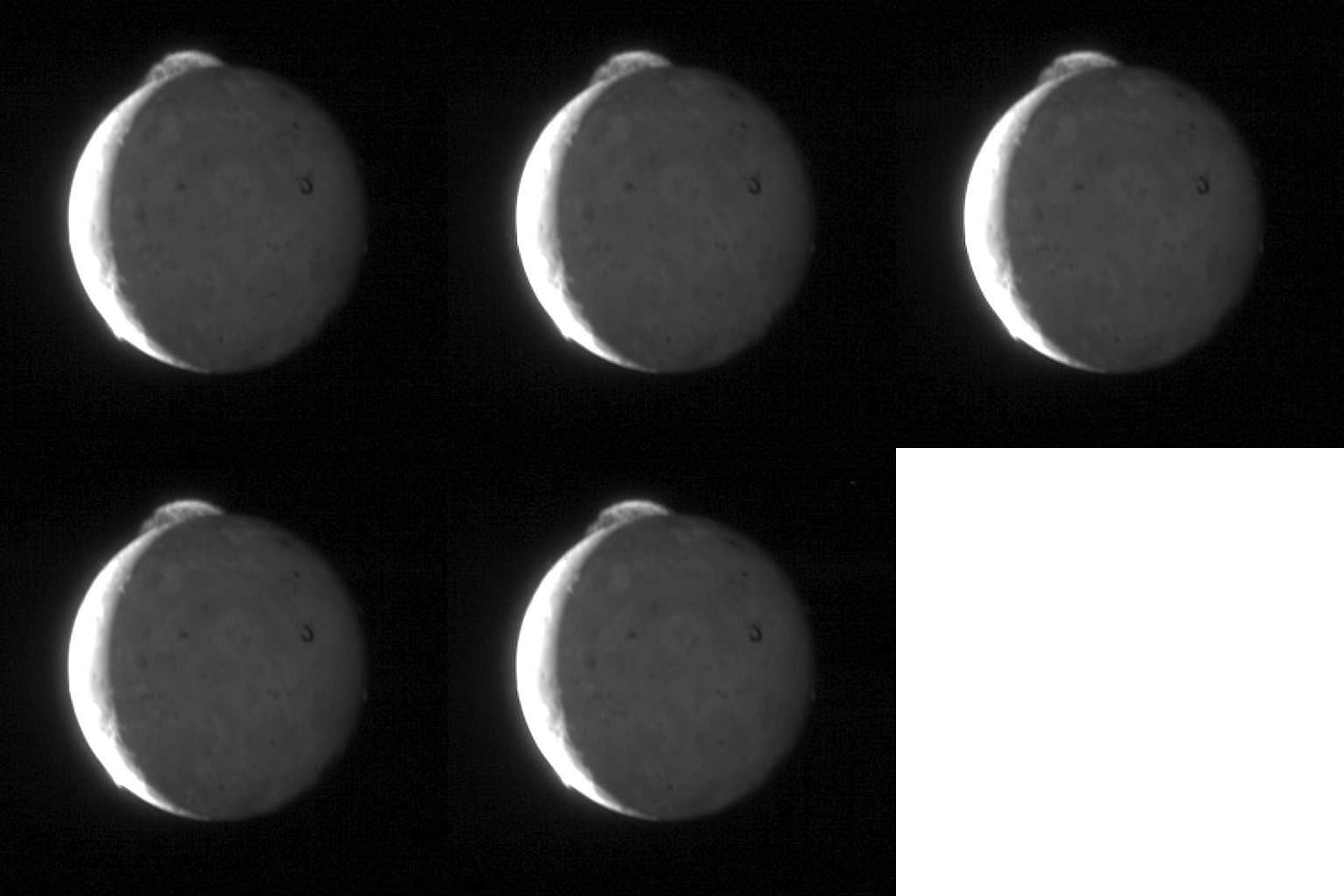
In the case of Io, we have compelling evidence for current activity. We have observed an active eruption on Io several times with satellite and orbital data. We have seen at least three major eruption events near the north pole of Io, in the Tvashtar Paterae region, since 1999. These eruptions result in massive volumes of lava being flung up into the air in the form of lava curtains or fountains that reach heights from 1 km to over 300 km high. Over 150 active volcanoes have been observed across Io. Fueling this activity is heat generated from Jupiter pushing and pulling on Io as it orbits the planet. Gases, mostly sulfur compounds, cause the lava to be ejected high into the air. These compounds also contribute to the yellow, red and orange colors of Io’s surface.

Series of images collected by the New Horizons spacecraft in March 2007 of an eruption of Tvashtar Paterae.
Venus appears to be volcanically active as well. We have long suspected Venus to be volcanically active and have had tantalizing evidence of the activity, such as transient changes in the atmospheric composition. Only recently, in 2024, did we discover convincing evidence of surface change. Herrick and Hensely (2024) positively identified a caldera (volcanic crater) that changed shape over the course of the NASA Magellan mission in the mid-1990s. There are other areas of Venus that are hypothesized to be active, but we need more recent observations to confirm volcanic activity in those areas. Luckily, NASA recently selected a couple of Venus missions. VERITAS, in particular, will be capable of imaging the surface at high resolution. We can use these images to confirm whether other areas have been active.

Caldera on the flanks of the Maat Mons volcano (yellow arrow) on Venus that changed shape from being more circular (left) to more similar to a kidney bean (right).
Related Topics
You may also like



.png)

We rely on the generous support of donors, sponsors, members, and other benefactors to share the history and impact of aviation and spaceflight, educate the public, and inspire future generations. With your help, we can continue to preserve and safeguard the world’s most comprehensive collection of artifacts representing the great achievements of flight and space exploration.
Support the Museum
We rely on the generous support of donors, sponsors, members, and other benefactors to share the history and impact of aviation and spaceflight, educate the public, and inspire future generations. With your help, we can continue to preserve and safeguard the world’s most comprehensive collection of artifacts representing the great achievements of flight and space exploration.