
Select Language

  • English
  • Español
Reserve Free Passes Membership
Visit
  • Visit

  • National Air and Space Museum in DC
  • Udvar-Hazy Center in VA
  • Plan a Field Trip
  • Plan a Group Visit
View of the Steven F. Udvar-Hazy Center tower at sunset

One museum, two locations

Visit us in Washington, DC and Chantilly, VA to explore hundreds of the world’s most significant objects in aviation and space history. Free timed-entry passes are required for the Museum in DC.

What's On
  • What's On

  • Events
  • Exhibitions
  • IMAX and Planetarium
Apollo 11: Buzz Aldrin on the Moon

At the museum and online

Discover our exhibitions and participate in programs both in person or virtually.

Explore
  • Explore

  • Stories
  • Topics
  • Collections
  • On Demand
  • For Researchers
space shuttle launch

Dive deep into air and space

Browse our collections, stories, research, and on demand content.

Learn
  • Learn

  • Programs
  • Learning Resources
  • Plan a Field Trip
  • Professional Development
Women in Aviation and Space Family Day

For teachers and parents

Bring the Air and Space Museum to your learners, wherever you are.

Give
  • Give

  • Donate
  • Become a Member
  • Wall of Honor
  • Ways to Give
  • Host an Event
Bob Hoover Gives an Air Show Performance

Be the spark

Your support will help fund exhibitions, educational programming, and preservation efforts.

H-1 Rocket Engine

  1. Breadcrumb Home
  2. Multimedia Gallery
  3. H-1 Rocket Engine

Select Language

  • English
  • Español
  • File URL

    A metal contraption that is larger than a person with a huge bell opening at the end.
    Download Image

    The H-1 rocket engine was an important part of the Saturn 1 and Saturn 1B rockets. These rockets were used in the early days of space travel to help get ready for the Apollo missions, which sent astronauts to the Moon. Each Saturn 1 and Saturn 1B rocket had eight H-1 engines that helped launch them into space!

    A company called Rocketdyne made the H-1 engine for NASA. It was really powerful because it burned a special fuel called RP-1, which is like kerosene, along with liquid oxygen. This engine created 188,000 pounds of thrust, which is a lot of power to send rockets into space.

    The H-1 engine was used in missions like Apollo 7 in 1968 and the Skylab space station missions in the 1970s.
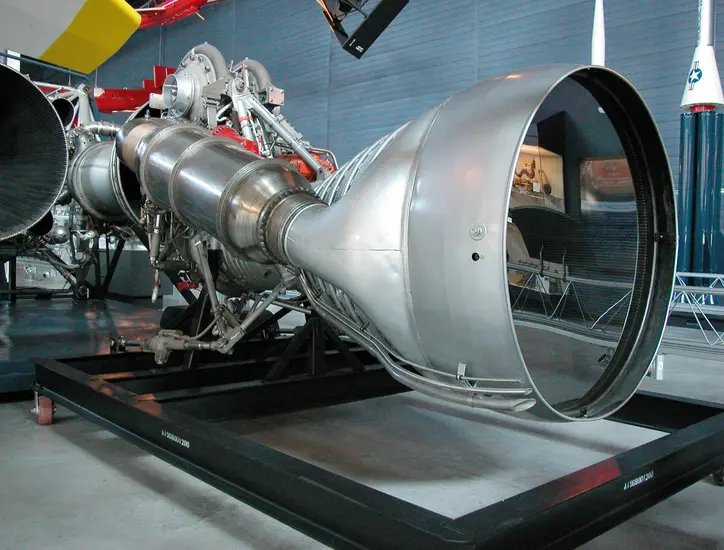
  • A metal contraption that is larger than a person with a huge bell opening at the end.

Created:

November 19, 2021

ID#:

A19680012000cp02

Source:

Courtesy of the Smithsonian National Air and Space Museum

Copyright/Owner:

Smithsonian Institution

Rights Usage:

Not determined

Terms of Use:

Smithsonian Terms of Use

For print or commercial use please see permissions information.

Admission is always free.
Open daily 10:00 am – 5:30 pm

National Air and Space Museum

National Air and Space Museum 650 Jefferson Drive SW
Washington, DC

202-633-2214

Free Timed-Entry Passes Required

Steven F. Udvar-Hazy Center

Steven F. Udvar-Hazy Center 14390 Air and Space Museum Parkway
Chantilly, VA 20151

703-572-4118

  • About
  • Become a Member
  • Newsroom
  • Host an Event
  • Get Involved
  • Contact
  • Privacy
  • Terms of Use
  • Accessibility